
Michigan Mineralogical Society
Michigan Mineralogical Society


Finding Michigan Rocks

Collecting Rocks in Michigan
Michigan is a fantastic state for rock collecting, and with all the copper, fossils, Petoskey stones, and beachcombing one can do, our state's beauty is hard to surpass. The articles on this page were taken from the Mineral of the Month section, local newspapers, online stories and curated here for the collecting community and beachgoers everywhere. These articles are designed to inspire and educate on the many wonders that Michigan offers in beautiful stones, minerals, and fun finds throughout the state.
10 Best Rock Hunting Beaches in Northern Michigan
It was a very close call, but these are our readers' top 10 favorite rock-hounding haunts in our 2019 Red Hot Best of Northern Michigan contest. If you go, good luck, and save some for the rest of us!

Finding Petoskey Stones
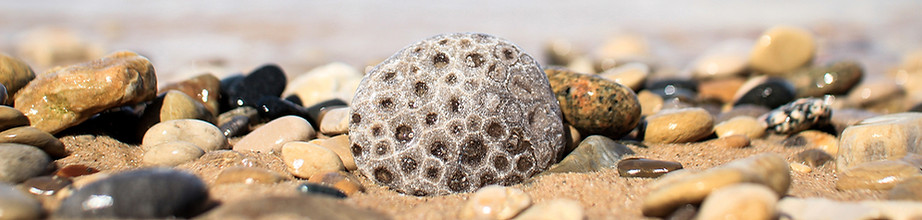
Photo Credit to rockseeker
Story by Bella DeMascio of Michigan Beaches
Michigan's state stone, the Petoskey stone and its lesser-known cousin, the Charlevoix stone are favored unique treasures for beach-goers. Though elusive and sometimes tricky to find, these stones remain a beloved symbol of our Great Lakes and the magnificent shores along them. So how do you find the elusive Petoskey stone?
What is a Petosky Stone
About 350 million years ago, Michigan was actually located near the equator, and a warm, shallow, tropical sea covered the land. Here, massive colonies of rugose coral (hexagonaria percarinata) thrived in reefs. It is the fossils of these corals that make a Petoskey stone. Petoskey stones are unique rocks that sport a tightly-packed hexagonal pattern all over their surface. This pattern is the fossilized pattern of the prehistoric rugose corals. Each hexagon on a Petoskey stone was once a coral polyp and the dark center of each one was once the mouth, which used tentacles to feed the coral.
Tips for Finding Petoskey Stones
Petoskey stones and Charlevoix stones look a lot alike. Both are beautiful and great finds, but knowing the differences can ensure you get exactly what you're looking for. Though they are both fossilized corals from approximately the same time in history, there are subtle differences. The easiest way to tell the difference is that Charlevoix stones have a smaller hexagonal exoskeleton pattern compared to Petoskey stones (see below for an example).
Michigan is home to many beautiful sandy beaches where people enjoy sunbathing and swimming. Leave those beaches to sun and fun and instead explore smaller, rockier beaches. Additionally, you should know that Petoskey stones are not exclusive to the waterline, check the shore before the water and even in surrounding areas near uprooted trees or any other disrupted soil. The average stone hunter won't think to look in these lesser-known spots. If you're on the lookout, you can find Petoskey stones all across the Lower Peninsula.
Petoskey stones are no secret, and many people flock to beaches in hopes to collect some, which can make them hard to find. However, this doesn't necessarily mean you need to discover some new secret spot. Instead, simply moving down the beach away from areas near parking lots and beach access points can benefit your search since these areas are less likely to have been picked over by other beach-goers.
Beachcombing after a storm is the best time if you're looking for Petoskey stones. The patterns on Petoskey and Charlevoix stones are more easily seen when the rocks are wet, making rain your friend in this search. Storms in particular are best though because the wind and waves disrupt the sand and allow Petoskey stones to wash up on shore or surface from under the sand. Just be sure the sky is clear of lightning before heading out to the water.
Petoskey stones are often found in clusters. If you find one, keep looking; you may be able to take home a few, just be careful not to take too many. Be mindful of other fossil hunters and the Michigan beach environment. Allow others to enjoy the beauty of Michigan's beaches and the joy of finding their own treasure in the Petoskey stone.
Know the Law
The state laws say you cannot collect more than 25 pounds of stones, minerals, or fossils per year from Michigan beaches. This is a state-wide law, but each beach or state park will have its own policies. These regulations can include the collection of Petoskey stones, Charlevoix stones, or other matter from the beaches, so be sure to check the local laws or park policies before taking home a souvenir. Remember, in National Parks you cannot collect or remove rocks!
Where to Find Petoskey Stones
As the name suggests, Petoskey is a popular destination for rock-hunters looking for the state stone. The beaches of Charlevoix are also popular, but you're still more likely to find a Petoskey stone since Charlevoix stones are the rarer of the two. These stones are not limited to their namesake locations, however, and appear in many places along the northern Lake Michigan shore and across the Lower Peninsula.
Here are some of the best locations for finding Petoskey or Charlevoix stones:
Sources: https://mymichiganbeach.com/blog/petoskey-stones, https://www.michigan.org

Photo Credit to Kathleen Smith - Frankfort Moments
Michigan Beach Photo with a Couple of Petoskey Stones
A Guide to Finding Yooperlites

Photo Credit to Erik Rintamaki - Taken with UV Light Source

Article Credit to Steph Castelein
Yooperlites® have been found in different areas throughout Michigan but are most prominent in the Upper Peninsula along Lake Superior. The beaches near the Grand Marais area and the Keweenaw Peninsula are popular destinations for those searching for Yooperlites®. Some people have reported them in gravel pits in Minnesota, in Lake Michigan near Chicago, and even near Point Betsie.
Yooperlites were discovered in 2017 by Erik Rintamaki, who gave them their regional northern Michigan name. This makes them a relatively new discovery, but they aren't exactly new to the state. They're made up of mostly syenite rock, which is similar to granite, which means the rock looks like any other dark stones or typical gray rock, but there's a twist. Yooperlites are rich with fluorescent sodalite, which glows a vibrant orange or yellow under Ultraviolet Light.
These glow-in-the-dark deposits of sodalite can form various patterns, including sparsely spotted, geometric lines, and an all-over pattern reminiscent of a galaxy somewhere in space. Each stone is unique and may even host a mix of patterns of the fluorescent sodalite, adding to the ever-growing list of what makes this glowing rock so magnificent.
We recommend searching for Yooperlite in the early springtime (from late March into April). In spring, the ice has shifted, and the rocks that have been stuck all winter are pushed up to the shoreline. Spring also gets you on the beach before they get busy during the summer season, meaning the rocks haven't already been picked over. As a bonus, there are fewer of those pesky mosquitos in spring!
Ensure that you follow the local laws on what can be taken from the beach or areas you're looking for, and always make sure you're on public land! Don't go unprepared, and don't go out alone. Many places along Lake Superior don't have cell phone service. Know where you're going. Respect private property and be aware of the regulations in your state for harvesting rocks or minerals. Follow the rules of the State of Michigan - you are allowed to harvest up to 25 pounds of rocks per year (DNR).
A Few Things You May Need:
UV Light: Most importantly, a UV light! A filtered 365nm UV light will showcase the Yooperlites® and feature their glowing color the best. Do rely on a UV light as your only light source; a good flashlight is still needed.
Headlamp/flashlights: It gets dark out there! Make sure you have an extra light to help you get back to your vehicle safely. Always have two in case one goes out while you're looking.
Bag: You need something to keep your Yooperlites® in! A mesh bag works great when you're in the sand and near the water.
Rock Scooper: Not necessary but can be helpful, especially if the rock you want is in the lake!
Appropriate Shoes: You're most likely going to be next to the water, so make sure you have the right shoes that can get wet and still have a good grip.
Water/Snacks: You never know what could happen. Always be prepared, especially when you're outdoors!
Warm Clothes: When night falls, it gets cold by the water. Wear layers and stay warm to make your Yooperlite experience more enjoyable.
Glow Sticks: It's easy to get disoriented, especially in the dark. Glow sticks can help you identify where you entered the beach and make sure you get back to your vehicle safely. Make sure you place them away from the water to ensure they don't wash out into the lake.
Sources: https://www.michigan.org/article/guide-finding-michigan-yooperlites, https://mymichiganbeach.com/blog/yooperlites, https://www.beachcombingmagazine.com/blogs/news/yooperlite

A Yooperlite® under normal light (left) and UV light (right).

Beachcombers showing their Yooperlights® using UV flashlights.
Fluorescent Finds in Leland After Dark
On the shorelines of Van's Beach in Leland, Michigan, rockhounds are finding slag glasses and mineral prizes. Some of the slag glass (sometimes called Leland Blue which has been around for over 100 years) is prized for its beautiful colors that were remnants of the old iron ore smelting process, and they were dumped into the great lakes at various places. But usually, after the sun sets, most rock hunters return home because it's pretty difficult to see the pretty colors that can stand out when it's after dark. But if you happen to own a good LED UV flashlight that casts a purplish glow at 365nm, there might be a hidden treasure waiting for you.

UV Illumination
Normal Light
Rich blues, reds, purples, and steaked fluorescent colors pop from the dull stones revealing surprising colors that no one knew were there until recently. With the popularity of hunting for Yooperlights or fluorescent sodalite in the last couple of years, many folks are going out to the beaches at night to see what they can discover with their UV flashlights. Rocks that are not even noteworthy in daylight are revealing their secrets under this UV illumination to those who are willing to look. And it's not just slag glass that's lighting up; sometimes calcite and fossilized corals will fluoresce as well. While many of the stones are easily skipped over by day, nighttime gatherings can offer a whole new experience.
Of course, be very careful going out after dark; always go with a friend and dress prepared for Michigan weather.
Sources: https://www.michiganrockhounds.com/articles/fluorescent-slag, https://www.clickondetroit.com/features/2022/06/22/who-knew-beaches-in-the-dark-could-be-so-fun-fluorescent-rocks-found-on-michigans-shores/
Hunting Fossils in Michigan
Fossil Hunting with Paleo Joe & Roy Webber in Escanaba from Discovering Programming.
Fossil Hunting with Wildkyle in Alpena Michigan
Believe it or not, Michigan used to be a lot more like the Bahamas. The state of Michigan used to be covered by a warm, shallow sea and was later an unforgiving glacial landscape. Common fossils found here are trilobites, corals, sea lilies, and even mammoth teeth. In Michigan, we have very weathered rocks along our shoreline. Because of all the beaches and many natural places around and all throughout Michigan, there are many places to find fossils. Here are the main examples.
Fossil Finds of Michigan
Coral-Like Animals
Corals were a common component of ancient life in Michigan. There are many types of corals or animals that look like corals – like bryozoans (moss-animals) and stromatoporoids (sponges). These animals often live in colonies but sometimes are solitary animals. Michgan has many fossils of sea sponges, horn corals, branching corals, and of course Petosky Stones which are fossil coral.
Sea Lilies
Sea lilies and related animals often have a star-like pattern or five-fold symmetry. These animals are related to sea stars and sea urchins but their ‘five-ish-ness’ may come in stranger shapes and sizes. They may even look like small rocks. Sea lilies and blastoids are common finds in Michigan. These animals would have had a root-like structure to attach them to the seafloor, a stem to elevate them in the water, and arm-like structures to help with feeding. Usually, we find pieces of the stems or their bodies. These types of fossils are called Blastoids and Crinoids. Even though they are primitive animals, you might mistake their fossils for plant fossils.
Trilobites
Trilobites are one of the earliest known groups of arthropods (including animals like lobsters or crabs) as well as one of the most successful early animals, living for over 270 million years. Trilobites are shaped like horseshoes, and often appear to have two main sections: a head and a body. The body is very segmented, making it relatively easy to recognize. In many cases, the segments will break apart and you will find pieces of the trilobites. A couple of trilobites commonly found in Michigan are the flat-tailed and the rounded-head trilobite.
Shells
Shells are a common fossil found in Michigan. The animals that make the shells can be quite different – ranging from snails to squids to brachiopods. The shells are a variety of shapes and sizes. Two very common types of shells found are those of sea snails and brachiopods. Brachiopods can be found on and around the beaches near Alpena, Michigan. The Rockport recreation area north of Alpena has an abandoned limestone quarry where many fossils, including Brachiopods, can be found. Brachiopods and other fossils can be found along Lake Michigan around the Petoskey area.
Plants
Rocks from the Carboniferous Period in Michigan contain various plant fossils, with localities in Jackson, Ingham, Eaton, Shiawassee, Saginaw, and Bay Counties being well-documented. Coal deposits are also found in Michigan. Some commonly found fossil plants are Club mosses (fossils can look like lizard or pineapple skin), Stigmaria roots (similar to lilypad roots), and Calamites (think horsetail plants).
Bones and Teeth
Vertebrate fossils are relatively rare in Michigan and can range from fragments of the plates of prehistoric armored fish preserved in Devonian rocks to nearly complete skeletons of mastodons and mammoths in the wet, sticky, marl (carbonate-rich mud) of the Pleistocene. This is a broad category, and it is much more common to find bones and teeth from modern animals than to find fossil bones, but every year people find Mastodon bone fragments and all kinds of interesting things.
Fossil Database of Michigan
Included below is a PDF you can download of places to find different fossils in Michigan. Permission is granted to use any materials on these pages under the V2.5 Creative Commons License.

Click to Download the Michigan Fossil Database

Fossil Hunting Map of Michigan with the Ages of the Sediments
A Great Resource
If you want help identifying something really cool you found and you think it's a fossil, but you are not sure what kind of animal or plant it came from, contact the Paleontology Museum at Paleo-Museum@umich.edu.
University of Michigan Museum of Paleontology: The University of Michigan Museum of Paleontology provides the facilities enabling the direct hands-on study of plants and animals preserved as fossils, and the study of the environmental, ecological, and paleogeographical conditions in which they lived. These can be studied statically at fixed times in the past or present, and dynamically as they are seen to change through evolutionary and geological time. Because of the Museum and what it facilitates in terms of hands-on experience, their teaching and research programs have long been known for their empirical focus, with an emphasis on testing new ideas as well as generating them.
Sources: https://umorf.ummp.lsa.umich.edu/wp/mis-backyard-fossils/, http://www.fossilspot.com/STATES/MI.HTM
The Michigan State Gem
Isle Royale Greenstone
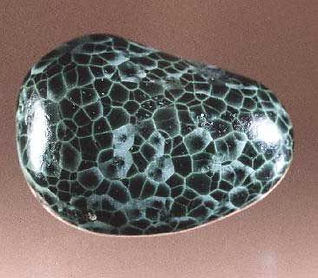

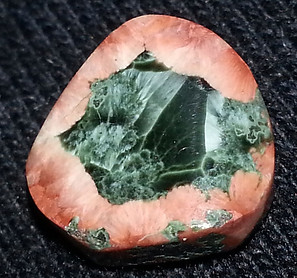
The official State Gemstone of Michigan is the Isle Royale Greenstone (Chlorastrolite). It was picked in 1972 to be the Michigan Gemstone after the lapidary community lobbied the State Legislature to pass it into law. Governor Milliken signed the Bill. Reportedly the lawmakers had some smart remarks to make before they were finished. One Senator from Kalamazoo (Anthony Stamm) said It looks like stuff I put on my driveway at $40 a load. Another legislator wanted to know if Chlorastrolite was any relation to the stuff that clogs arteries. Another lawmaker explained that If you think my wife is going to trade in her Diamond for a Greenstone, you have rocks in your head.
Chlorastrolite is Hydrous Calcium Aluminum Silicate. It commonly has a polygonal mosaic pattern, sometimes referred to as an alligator pattern. Chlorastrolite is a variety of the mineral Pumpellyite. It can be light or dark green, but the pattern is much showier in lighter shades. Lighter green predominates Greenstones from Isle Royale, while many Keweenaw Greenstones are darker. A desirable Greenstone trait shows radiating lines exhibiting Chatoyancy like Tiger-eye. A solid Greenstone has a hardness of 5.5 to 6.
Chlorastrolite is formed in vesicles (small holes in bubbly Botryoidal lava) in the upper strata of the lava flows. In many cases in the Keweenaw, the vesicles do not completely fill in, and you get hollow nodules. If you're really, really lucky, these might fill in with Copper, Prehnite, or Thomsonite, making them an extraordinary find.
The mineral's history dates back roughly 1.1 billion years ago, to the age of the Midcontinent Rift: A time when North America began to split apart at the seams, causing lava to spill out of the Earth's crust along a fissure that ran from Kansas up to present-day Lake Superior and back down to where Detroit now is. Those lava flows, which could be thousands of feet thick in some places, eventually cooled into a rock we call basalt. Within that basalt were small pockets of empty space left behind from gasses in the lava – and that is where chlorastrolite eventually formed.
Of all the land along that original Midcontinent Rift, the Lake Superior region is the only place where those veritable floodplains of basalt became exposed, making it the only place to find chlorastrolite. Adding to its scarcity, chlorastrolite is also tricky to find because of its size. Large pieces are scarce; they are often seen as pea-sized nodules or needle-shaped crystals lodged within larger chunks of basalt or, when the water has eroded the basalt around it, like pebbles or even granules.
A Greenstone found underwater off Isle Royale in1961 by Arthur Vierthaler is in the Smithsonian and is claimed to be the largest Greenstone ever found at one and a half inches by three inches.
It's usually found as bean sized, rounded beach pebbles in Michigan. Polished stones are used for stickpins, rings, earrings, cuff links, pendants and are sometimes incorporated into inlays and mosaics. Because Michigan Greenstones come from such a limited area of the world, few people have ever seen one. They are basically a one source gemstone, and that source is the Isle Royale National Park (where they're illegal to remove), or in the Keweenaw Peninsula, where they're becoming more scarce because of all the Private property and all the old dump piles having been crushed and hauled away for road fill. Collecting Chlorastrolite from Isle Royale National Park is now prohibited).


Chlorastrolite is a bluish-green to dark green stone with a pattern of slender, star-like crystals, which results in a "turtleback" pattern. Some chlorastrolite includes other minerals, which produce additional colors. Other names for the Greenstone are "green star stone" or "turtleback". It does look very much like a turtle shell!
Sources: https://statesymbolsusa.org/symbol-official-item/michigan/state-gem-gemstone/isle-royale-greenstone, https://www.snobappealjewelry.com/blog/chlorastrolite-aka-greenstone, https://www.mlive.com/entertainment/erry-2018/04/64a09f0d318324/isle_royale_greenstone.html
Finding Lake Superior Agates

Lake Superior Agates can be found along the shores of Lake Superior, from Whitefish Point up through Wisconsin and Minnesota. The Lake Superior agate is noted for its rich red, orange, and yellow coloring. This color scheme is caused by the oxidation of iron. Iron leached from rocks provided the pigment that gives the gemstone its beautiful array of color. The concentration of iron and the amount of oxidation determine the color within or between an agate's bands. There can also be white, grey, black, and tan strips of color as well. Agates can also be found inland in Minnesota, along gravel roads in the Upper Peninsula, and in ditches alongside roads. A great time to look is at sunrise or sunset when the glean of the sun is shining at an angle and the glint can be seen off of the quartz-rich agates. Keep in mind that there's no collecting allowed in the Pictured Rocks National Lakeshore, as it's a national park.
Where can you Find Lake Superior Agates?
One of the most appealing reasons for naming the Lake Superior agate as the Minnesota state gemstone is its general availability. Glacial activity spread agates throughout northeastern and central Minnesota, northwestern Wisconsin, Northern Iowa, Nebraska, Kansas and Michigan's Upper Peninsula in the United States and the area around Thunder Bay in Northwestern Ontario, Canada. Lake Superior agates have been found in gravel deposits along the Mississippi River basin. Other types of agate similar to Lake Superior agate have been found in southwestern Wisconsin.
What is an Agate?
Agate is translucent to a semi-transparent form of chalcedony (quartz). If you have a piece that is semi-transparent you will be able to hold a very thin piece up and see distorted or foggy images through it. If you hold a translucent piece up to a source of light you will see a small amount of light passing through the thin edges.
Agate is generally a banded material, and observing bands in a specimen of chalcedony is a very good clue that you have an agate. However, some agates do not have obvious bands. These are often translucent agates with plume-shaped, dendritic, or mossy inclusions.
Many agates form in areas of volcanic activity where waters, are rich in dissolved silica (SiO2), flow-through fractures, and cavities in igneous rocks. When the solution is highly concentrated with dissolved silica, a silica gel can form on the walls of these cavities. That gel will slowly crystallize to form microcrystalline quartz.
Over time, additional layers of gel are deposited and these form younger bands of microcrystalline quartz on the walls of the cavity. If the dissolved mineral composition of the silica-rich water changes over time, impurities (elements other than silicon and oxygen) can be incorporated into the gel and into the microcrystalline quartz. These impurities can alter the color of the microcrystalline quartz. This can produce color banding. Crystallization of foreign materials is often what forms the plumes, dendrites, or mossy structures that are often seen in translucent agate.
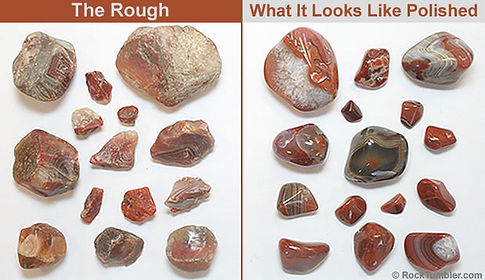
Examples of Lake Superior Agates Before and After Polishing

Sources: https://en.wikipedia.org/wiki/Lake_Superior_agate#Geologic_history, MMS Club members, Rock Tumbler.com, https://www.geologyin.com/2017/06/where-and-how-to-find-lake-superior.html, https://showmerockhounds.com/2014/10/14/lake-superior-agates/


Charlevoix Stones
Michigan's other Petoskey Stones


Charlevoix Stones, Favosites & Fossilized CorAls
We are poking fun, but Michigan is such a great place to collect rocks, why not add some more help in finding interesting stuff on our shorelines and driveways that look like Petoskey Stones, but they're not! A Pesotsky Stone is a fossilized coral, a Charlevoix Stone is a fossilized coral, and a Favosite is a fossilized coral, but a Favosite is not a Petosky stone. Clear??
The Charlevoix stone looks a lot like its cousin, the Petoskey stone. It’s smaller in total size but is especially distinguished by its smaller honeycomb-like patterns. The two are sometimes confused, and it's easy to see why: Both are shades of soft gray or beige, freckled with honeycomb patterns, and are found in the same areas around Michigan, usually along shorelines in the northern parts of the state. Like the Petoskey stone, the Charlevoix stone is a remnant from the ancient period of Earth history when the land that we now call Michigan sat at the bottom of a shallow sea.
Paleontologist Jen Bauer, a research museum collection manager at the University of Michigan’s Museum of Paleontology, said that while both Charlevoix and Petoskey stones are fossilized coral, the two are from different taxonomic groups: Petoskey stones being from the major group “Rugosa,” while Charlevoix stones are from the group “Tabulata,” a nod to the tabulae, or small square-ish shapes, that make up their intricate design.
While the two groups’ time on Earth overlapped, the coral species that gave us Charlevoix stones were much longer lived. Charlevoix stone coral belongs to the now-extinct genus Favosites, which existed on the planet for nearly 200 million years, some 450-250 million years ago. Favosites consist of a series of calcitic tubes (corallites) packed together as closely as possible, thus the resemblance to a honeycomb. The openings for the coral polyps are much smaller than in Petoskey stones and look like a lace pattern draped over the rock.
Meanwhile, the genus of coral that included the Petoskey stone, Hexagonaria, was around for less time -- about 57 million years. (For a mind-bending comparison, consider that anatomically modern humans are generally believed to have been around for only about 200,000 years.)
The reason both Charlevoix and Petoskey stones are so prevalent here in Michigan is due not only to our state’s geological past but also it's present. “Michigan’s history is pretty unique,” Bauer said. “We also have these really beautiful lakes that churn up the stones. You could find these corals in other places, but you don’t find the really beautiful polished stones like you do in Michigan.”
Sources: https://www.mlive.com/news/2020/07/meet-the-charlevoix-stone-a-petoskey-lookalike-thats-become-a-michigan-rock-hunting-treasure.html, https://greatlakeslocals.com/12-collectible-rocks-and-fossils/
Petoskey Stone and Charlevoix Stone
Michigan ROCKS!
A Nice Tumble of Charlevoix Stones
Gold, Silver & Copper
Michigan's Precious Metals
Many people are surprised to discover that Michigan is the home to precious metals. For centuries, gold, silver, copper, and diamonds have been found here. Records available at the U.S. Forest Service in Cadillac indicate that gold has been found in over 100 places in Michigan. Gold has been discovered in 27 of 68 counties in the Lower Peninsula and 6 of 15 counties in the Upper Pennisula.
Gold
Gold was first discovered in Michigan by Douglass Houghton, the first state geologist. Appointed to the post in 1837, Houghton made several visits to the Upper Peninsula, reporting on the copper wealth existing there. In 1844, he convinced Congress to finance a joint geological and linear survey of Michigan.
While camped near the present site of Negaunee in 1845, Houghton returned from a solo excursion with rock specimens carrying enough free gold to fill an eagle’s quill. Fearing that his men would desert to prospect for gold, he kept the find a secret. Houghton only revealed the discovery to his trusted associate Samuel Worth Hill, the veteran mineral explorer whose penchant for spicy language has been immortalized in the euphemism "What the Sam Hill!" Unfortunately, Dr. Houghton drowned later that year when his canoe capsized in a storm near Eagle Harbor, and the exact location of his gold find died with him.
Finding Gold in Michigan
Michigan, like most states on the eastern side of the US, has a small amount of placed gold, most of it put there as glacial deposits thousands of years ago. Gold can be found throughout the state, but you are not likely to find any substantial concentrations like you would in some of the more well-known gold-bearing states. Both the upper and lower peninsula have produced fine gold throughout the rivers and creeks.
One noteworthy area is the Ropes Gold Mine north of Ishpeming in Michigan’s Upper Peninsula. In 1881, Julius Ropes discovered gold in some rock outcroppings there and formed the Ropes Gold and Silver Company to expand works on his new discovery. Gold mining continued for decades, changing hands numerous times until it was closed in 1991. Ore values were generally low, but new extraction methods allowed the mine to remain active (off and on) for over a century. Other gold discoveries have been made across the state, but most have been very low grade, and gold production has been a byproduct of other mineral extraction efforts like zinc or copper.
The area around Ishpeming, Michigan is worthy of investigation for the hobby prospector. In addition to the Ropes Gold Mine, reports of gold deposits occur throughout several creeks and streams in the area.
Silver
Native silver occurs in a variety of vein and lode deposits of hydrothermal origin. In Michigan, it is found in the Keweenaw’s native copper deposits and in certain hydrothermal gold-quartz and lead-zinc veins in Marquette County. Silver has been recovered from Lake Superior on the north side of Keweenaw Point, whereas glacier copper is reported from both sides of the Point. The term “half-breed” has been used to describe an intergrowth of native silver and native copper.
Classic specimens of crystallized native silver have long been obtained and eagerly sought from the native copper deposits. The history of Michigan silver has been reviewed by Olson (1986). Although silver was produced in relatively large amounts, it commonly was not recorded under company production records, as both miners and managers regarded it as their personal and private property whenever it came within their reach. By 1977 the recorded silver production for Marquette was 16,469,544 troy ounces, but the actual total may have been twice as much.
Michigan’s Copper Prospecting
The top place known for copper nuggets, and where metal detecting can be conducted is the Keweenaw Peninsula in the northern region of Michigan State. Most nuggets are found within Houghton County, where it is popular for treasure hunters to search for large nuggets with metal detectors. At the far northern tip of Keweenaw Peninsula is Copper Harbor. The area spanning all the way from the northern tip of the peninsula down to White Pine are productive. The largest copper nuggets ever found have come from this region. Even though Michigan and a few other states have copper mines, finding a copper nugget is very rare on earth. This makes Michigan a rare place indeed!
Finding Copper in the U.P.
The Keweenaw Peninsula of Michigan has been nationally famous for over 100 years for its history of highly productive copper mining. The local basalt is criss-crossed with many thick veins of native copper that made up the main ore of many of the mines. Solid natural masses of copper weighing hundreds of pounds were found with relative frequency at the mines. Though these pieces certainly were the most valuable ore, the best specimens from the area are clusters of well formed copper crystals. Other metallic minerals can be found with the native copper such as silver, domeykite, mohawkite, and chalcocite. Many other interesting minerals like datolite, analcime, prehnite, agate, and thomsonite are also abundant in the Keweenaw Peninsula. While all the mines of the region are closed to copper production, many are maintained as museums and fee dig sites. There are also many abandoned mines in the area that can provide good digging in the dumps but be sure to acquire permission from landowners before visiting any location on private land.
Sources: Parts of the text on this page come from "Michigan Gold Mining in the Upper Peninsula" by Daniel Fountain. (1992, Lake Superior Port Cities, Inc.), https://museum.mtu.edu/pdfs/SILVER.pdf, https://howtofindgoldnuggets.com/find-native-copper-nuggets/http://wheretofindrocks.com/collecting-copper-in-michigan/

Michigan's Central Mine: Copper Trapped Inside Calcite Crystals

Michigan Mine (Michigan Gold Mine), North Lake, Ely Township, Marquette Co., Michigan, USA

Silver: Michigan Mine, Ontonagon County, Upper Peninsula of Michigan

Silver on Copper: "Half Breed". Wolverine Mine, Wolverine, Houghton Co., Michigan

Silver on Copper: Mohawk Mine, Keweenaw County, Michigan

Central Mine, Keweenaw County, Upper Peninsula of Michigan: Copper Crystals
Fulgurites
Lightning's Glass Artwork
Even before man learned the secret of glassmaking, nature made glass in two ways. The heat of volcanic eruption fuses rocks and sand into a glass called obsidian. When lightning strikes sand, the heat fuses it into long, slender glass tubes called fulgurites. They are commonly called petrified lightning, or lightning sticks. The fulgurite is nature’s glass… irregular in shape and nontransparent. It takes on a greenish color depending on the hue of the sand as the lightning strikes.
When lightning strikes the sandy soil, a chemical reaction takes place. Sand melts at a temperature of 3,270 degrees Fahrenheit, so the heat from the lightning quickly turns it into a liquid. Much cooler surrounding air and sand cools it and it turns into a glass-like substance called fulgurite! All this happens in the timespan of about one second.
The fulgurites are very brittle and will break from the vibrations when digging or just the pressure from the sand itself. Fulgurites are all different shapes and sizes, and once they start down into the sand, they will branch off the main finger, just like a flash of lightning in the sky. While some are quite round and hollow, many are flattened and roughly shaped because of the pressure exerted by the surrounding sand on the fulgurite at the time when it is very hot and plastic-like. The insides are often smooth and glassy.
Silver Lake is one of the few areas in Michigan known for finding these fulgurites. Mac Wood’s Dune Rides has one of the largest displays of fulgurites, including one piece that is 9 feet long.
Sources: https://macwoodsdunerides.com/learn/fulgurites/, https://www.abc57.com/news/fulgurite-is-lightnings-work-of-art, https://lakemichigandestinations.com/sand-dunes/whats-a-fulgurite/

Wiki Commons Sandy Fulgurites

Lake Bend Museum Fulgurite

Silver Lake Fulgurite Tube
Finding Pudding Stones

Visiting certain parts of Michigan, you might come across a unique-looking white rock with small colored stones seemingly stuck into it. Congratulations! You have just found a pudding stone! Formally, pudding stones are a type of sedimentary rock known as a conglomerate. Michigan’s pudding stones are conglomerates that have been metamorphosed into a metamorphic rock called quartzite. Pudding stones first got their name from their similarity to European settlers’ favorite fruit pudding dishes. Although many conglomerate rocks are referred to as “pudding stones,” the most widely recognized stone in the state comprises a base rock of white quartzite, with pebbles of jasper and other dark-colored inclusions. In North America, pudding stones are most commonly found across Michigan, around the Ontario peninsula, and less commonly on the surrounding coastlines of the Great Lakes.
Pudding Stones form from varying sizes of sediment (sands, usually) and pebbles. Smaller sands or silts surround larger pebbles and harden deep beneath the Earth’s surface. In the case of pudding stones, they are first formed from sand that is then metamorphosed into quartzite under heat and pressure. Current theories speculate that these rocks began initially in what is now Canada around 2.3 billion years ago and were carried to Michigan in the till of the Laurentide glacier, which covered the state approximately 24,000 years ago.
In North America, pudding stones are most commonly found across Michigan, around the Ontario peninsula, and less commonly on the surrounding coastlines of the Great Lakes. Pudding stones can be small to very large, even impossible to pick up.


Pudding Stone from Drummond Island by Paul Donelson
Tumbled and polished Pudding Stones from Geology.com
Close up of a natural Michigan Pudding Stone
Sources: https://www.beachcombingmagazine.com/blogs/news/puddingstones, https://rivergrandrapids.com/michigan-puddingstones/, https://geo.msu.edu/extra/geogmich/puddingstones.html,
Looking for Beach and Slag Glasses

Along the many miles of beach, there are all kinds of glass from bottles, old glass containers, and miscellaneous glasses that have fallen into the fresh waters of the great lakes. But there is another type of glass that you can find on many beaches along the shorelines. Beach glass and slag glasses are sought after by collectors and are commonly used to make jewelry. While beach glass is a pretty easy concept to grasp, slag glass is from the smelting industry, and its pretty greens, blues, and purples are a fun find. The color, amount of frost, and visible markings are all considered when determining the value of a piece of naturally tumbled glass. The most common man-made glass colors are white, brown, green, seafoam green, and amber. Rare colors include pink, aqua, cobalt blue, cornflower blue, yellow, orange, black, purple, and the rarest of all, red. The rarest and most sought-after slag glass is called Leelanau Blue. Typically a sky, to grayish-blue coloration.
How is Beach Glass Formed?
Beach glass is formed from discarded glass jars and bottles that have been thrown away in the water or left on shore and swept out to sea or in the Great Lakes, where it is tossed and tumbled by stones and the pounding waves.
The process takes 30 to 50 years, smooths the edges of the glass, and leaves a frosty, smooth exterior. The sea glass or beach glass, as it's now called, washes back onshore to be found by treasure hunters.
How is Slag Glass Formed?
Slag glass is a by-product of the iron and steel smelting industries. It is created when the raw iron ores are melted down to create pure iron. Silicate powders and sand are often added to the molten metals to help pull out impurities, and the slag is then separated and poured off into slag dumps. After the impurities cool, the result is slag. The different impurities and the number of air bubbles lead to the color and opaqueness of the slag. These slags were often just dumped into the lakes (before there were any environmental laws).
Where is Beach and Slag Glass Found?
We find beach glasses all around the Great Lake shorelines, at any time on just about any beach. Slag glasses are often found early in the morning or after a storm in specific locations where the metal and smelting industries used to exist. Slag glasses can be found in Frankfort, Cadillac, Elk Rapids, Fayette, Marquette— anywhere smelting was done. When the smelting industry ended in Leland, heaps of slag were dumped in Lake Michigan.
Famous and Collectible Slag Glass
The most collectible slag at the moment is Leland Blue. Many people collect it and make jewelry out of this smelting by-product. The cleaner blue and the larger it is, the better price it can fetch. Frankfort Green is also relatively well known, looking much like the green of a green wine bottle. It's common to find greys, browns, amethyst like purple and green slag glasses, and mixtures of these. It's just up to you and a jewelry maker to decide what it's worth.
How to tell if it's Man-Made Beach Glass vs. an Industrial Slag Glass
Man-made beach glass will often be one color and translucent throughout the entire piece. Beach glasses are usually not very thick as well, being that they were made from a glass bottle or standard thickness of glass. On the other hand, slag can be thick, vary in coloration, is often opaque, and may have ridges and odd stoney like shapes. See below for examples.

A Good Example of Some Common Beach Glass Finds

Polished Michigan Slag Glass Cabochons
Tips for Finding Beach Glasses:
-
Allow a minimum of an hour to search for sea glass.
-
Skip the pristine sandy beach for a pebbly beach with lots of rocks.
-
Go where the waves are.
-
The best time to hunt for beach glass is after a storm.
-
Visit the beach at low tide. Tides are lower around full moons so plan your hunt accordingly.
-
Don’t be afraid to wade out into the water if necessary.
-
Face AWAY from the sun and look for sparkles.
-
Begin your search near the lower low-tide lines or rocky areas, but search the entire shoreline if time allows.
-
Carry a small bag to collect the beach glass you find.
-
Use a small plastic rake or kitty litter scoop to sift through the sand.
-
Areas of wet sand may turn up the best finds but look closely, the white glass may look invisible.
-
Wear sturdy walking shoes for climbing down embankments when searching for beach glass along the shoreline near roads.
-
Do not hunt sea glass on private property unless you have permission.
-
Finished sea glass should not have any sharp edges. If the sea glass is not “mature”, throw it back and it will continue to circulate for other people to find.
-
The darker colors of sea glass may look like rocks at first glance so pay attention!
-
Never go far without someone with you! It's more fun and successful to look with a friend.
A Guide:
Michigan's Minerals A to Z
Did you ever wish that you had a handy, dandy guide to all the most common Michigan Minerals? Well, here it is. This guide was created by the Western Michigan Core Kids Group and Geology.com, along with the Michigan DEQ. All great sources of information. Feel free to download this guide and have fun exploring to see if you can catch 'em all. Always remember to be safe and bring a friend! Just click the image to download a PDF for yourself to keep on your phone or print out.

Yet...another "Lightning Stone"
These are Septarian Nodules locally called Lightning Stones. They were formed as a ball of clay on the ocean floor around 55 million years ago. Over time the nodules of clay cracked and the cracks were filled in with a white to yellow Calcite. They consist of clay cemented onto an iron mineral called siderite. These concretions form in part through bacterial activity. They become fractured and the fractures fill with calcite brought in by ground water. The results forms white lightning like patterns on a dark background, that resulted in their nickname.
They are found on beaches in the lower west side of MI. They can be found at Deer Lick Creek Park in South Haven, Pier Cove Park Beach near Fennville and in Van Buren Park as well as Western Lake Michigan.
These stones are pretty to look at, often have interesting patterns in them that can look like animals, or all sorts of things that you can image. They can be cut, polished and carved into jewelry too.
Septarian nodules can also found in Utah, New Zealand, England, Morocco, and Madagascar.

Michigan "Lightning Stones" or Septarian Noduals

Polished Cabochon for holding or Jewelry
Michigan beaches are some of the best in the world. That squeaky clean sand between your toes, beautiful fresh water beaches and so many interesting and colorful beach stones. This month we went vintage, picking up an old Michigan Department of Conservation flyer on the subject. Please download the higher resolution file to keep as a reference for looking them up next time you're enjoying the Great Lake State's shark-free waters.
Michigan Beach Stones
Text by Robert W. Kelly and sponsored by the Michigan Department of Conservation (older name for the DNR)
Our Great Lakes Shorelines are Treasure-laden with a host of truly fascinating gem materials, not only hard-to-find agates but also easy-to-find chert, jasper, granite, quartz, and basalt. Though more plentiful around Lake Superior, the common varieties may be found almost anywhere. No special training is needed for rock collecting. Just look for colors and patterns that please you. You're the judge. It's as simple as that. The variety of stones is infinite. Seldom are two precisely alike, so giving them names is also tricky. Unlike plants and animals, classes of stone grade one into another. Divisions are purely arbitrary based upon subtle differences in chemistry and texture. Sometimes, identity is difficult to establish, even in the laboratory!


One note about beachcombing along Michigan's Great Lakes: If private property signs are posted, you should obtain the property owner's consent. Please review the Michigan Supreme Court case Glass v. Goeckel, 703 N.W2d 1 (Mich.2005) to know the legalities of walking along the Michigan Great Lake shorelines. Permission is not required if you wade in the water, just off the beach. The submerged bottom lands of the Great Lakes are public, owned by all of us together. The specimens reproduced here are relative to their true size. Color will vary from computer monitor to monitor and by location. Photography is by John R. Byerlay and Robert W. Kelley of the Geological Survey Division, Illustration is by Jim Campbell, and the specimens.

Descriptions of the Stones shown in the Color Picture
1. AMYGDALOID – (Greek: "almond") Pebbles of basalt, or lava, with almond-shaped cavities created by gas bubbles trapped beneath the crust of a once molten rock flow. Green "amygdules" are chrysocolla: red, analcite. Note copper amygdules in pebble nearest upper left corner.
2. NATIVE COPPER – Michigan's "honor mineral." Specimens found in old mine waste piles usually have a green patina coating; when polished the bright copper color emerges.
3. NATIVE SILVER – Lake Superior copper is noted for its silver content that imparts "superior" qualities for many uses. Hammered nuggets of inter-mixed copper and silver are called half-breeds.
4. LAKE SUPERIOR AGATES – Typical beach specimens. Besides their inherent hardness and fine luster, concentric banding is a definite clue to the identity of two of these specimens. The specimen on the right, however, might easily go unnoticed.
5. LAKE SUPERIOR AGATES – A string of tumbled round agates of the size most commonly found.
6. LAKE SUPERIOR AGATES – Cut and polished gemstones collected at various beaches from Ontonagon to Sault Ste. Marie.
7. HONEYCOMB CORAL – the original limey skeleton of this fossil has been replaced by silica (quartz).
8. JACOBSVILLE SANDSTONE – not considered a lapidary material, but sometimes weathering processes cement the grains into a compact mass that takes a fairly good polish.
9. PREHNITE – a member of the zeolite mineral group, which also includes thomsonite, chlorastrolite, and analcite, common to the Copper Country. See the minute flecks of copper?
10. BRECCIA – (Italian: stone fragments)- Angular pieces of basalt fragmented in a zone of violent rock breakage and re-cemented with other minerals, often quartz or calcite.
11. JASPILITE – a specimen of iron formation in which the usual red iron oxide coloring has been weathered to ochre-colored limonite.
12. CONGLOMERATE – an aggregation or "conglomeration" of rounded pebbles cemented together by other mineral matter.
13. RHYOLITE – red to brown fine-grained type of igneous rock.
14. QUARTZ – with green epidote and red jasper.
15. QUARTZ – with red jasper.
16. EPIDOTE – in basalt.
17. BRECCIA – Fragments of basalt cemented by milky quartz with traces of red jasper.
18. EPIDOTE – in basalt.
19. BRECCIA – Fragments of basalt cemented by milky quartz with traces of green epidote.
20. FINE-GRAINED GRANITE – contains small interlocked grains of clear quartz and flesh-colored feldspar.
21. JASPILITE – Interbanded red jasper and grey hematite. The ever-increasing production of iron from occurrences of this ore is a vital factor in Michigan's economy.
22. PETOSKEY STONE – fossil colony coral and Michigan's official state stone.
23. RAW BEACH STONES – a collection of various hard unpolished pebbles, typical of Lake Superior shores, but also found elsewhere to a lesser extent. True cherts are usually white, pale brown, brownish yellow, red-grey, sometimes black, and occasionally green. In all cases, however, they consist of a dense, non-crystalline water-deposited form of silica that takes an exceedingly high polish. Colors are the result of other mineral impurities: iron oxide imparts the red color; green pebbles (basalts) are colored by epidote; glassy white to grey stones with frosted surfaces are usually vein quartz, a crystalline variety of silica.
24. THOMSONITE – Exquisite shades of pink and green with a radiant fibrous structure.
25. CHLORASTROLITE – the famous Michigan Lake Superior official gemstone, "greenstone".
26. TUMBLED BEACH STONES – Same as in group No. 23, except the inherent beauty of their colors and textures has been enhanced by tumbling.
27. RHYOLITE – A fine-grained igneous rock shaped into a convex gem form known as a cabochon. The group of four banded reddish-brown pebbles immediately beneath are also rhyolite.
28. CHERT – with small orbs of red jasper.
29. CHERT – just chert, but most unusual and pleasing gem specimens.
30. DATOLITE – often very colorful, and though not as hard as either agate or chert, takes a superb polish because of its very dense texture. Unusual, too, because it contains the element boron. Rarely occurs on beaches, but the two yellow pebbles were picked up on a Keweenaw beach fifty paces apart and their mates!
SOURCEBOOKS:
Rocks and Minerals of Michigan. Discusses stones, rocks, minerals, and mineral resources-where found and how to identify them. Collecting Minerals in Michigan. Basic suggestions for the beginning hobbyist, free. For both these, write Publications Room, Michigan Dept. of Conservation, Lansing 26, Michigan. Field Guide to Rocks and Minerals, universal pocket volume, Houghton Mifflin. Gemstones of North America, a comprehensive treatise on mineralogy and occurrence of stone deposits. Van Nostrand. Rocks and Minerals, "Golden Nature Guide" series, Simon & Schuster, paper-covered. 1001 Questions Answered About the Mineral Kingdom, "1001 Questions Answered" series, Grosset & Dunlop, paper-covered.
MAGAZINES:
Earth Science, Gems & Minerals, Lapidary Journal, and Rocks and Minerals.
MAPS:
U.S. Geological Survey topographic quadrangle maps are available from the Geological Survey Division. Individual county maps showing the location of State and Federal lands available for public recreation are distributed at Department facilities throughout Michigan. They may also be obtained from the Publications Room.
EXHIBITS:
Michigan College of Mining and Technology, Houghton. Cranbrook Institute of Science, Bloomfield Hills. Fort Wilkins State Park, Copper Harbor.
Original Source: Michigan Department of Conservation
Omarolluk or "Omars" - The Holy Rock
Omars, are a distinctive type of deposited stone that consists of dark siliceous greywacke and exhibits prominent rounded, often deep, hemispherical voids and pits. The spherical voids and pits result from the dissolution of carbonate concretions within the greywacke. The Omar is identifiable by its grey to tanish-grey color and having what might be a scoop carved out of it. This is why they are also called "Cup-Stones".
Omars have a color and texture like Keweenawan basalts, but they are fine-grained sedimentary rocks, made up of sands derived from basaltic rocks. What makes them distinguishable is the spherical features, often being holes, that are usually between a half-inch and 3 inches in diameter. The holes are eroded concretions, and many of the concretions are still wholly or partly preserved. The concretions are relicts of cyanobacteria colonies that grew in the water that was between sand grains in the sediment. Their rounded shape, whether found in glacial tills or glacial gravels, indicates that they were eroded from old existing littoral or fluvial deposits. Omars are often found associated with deposits from glaciers.
The name given to these stones refers to their source, which is the Proterozoic Omarolluk Formation in the Belcher Islands in southeast Hudson Bay. The Laurentide Ice Sheet eroded omars from the Belcher Islands. Because scientists know precisely where they came from they are very valuable in documenting the movement of glaciers.
Sources: https://en.wikipedia.org/wiki/Omarolluk, https://www.geo.mtu.edu/KeweenawGeoheritage/BeachStones/Omars.html, https://forums.arrowheads.com/forum/information-center-gc33/pseudo-artifacts-geofacts-gc98/geofacts-fossils-commonly-mistaken-for-artifacts-gc99/181607-rocks-with-holes-and-cups, https://www.pinterest.com/pin/144537469279692126/

Hand Holding an Omarolluk "Cup Stone"

Collections of Omars for Size and Shape Comparisons.