
Michigan Mineralogical Society
Michigan Mineralogical Society


Photo Contest

Currently running club competitions
We formally open our next annual club photography contest! We are actively taking club member photography submissions for our 6th club-wide Millie Hurt Mineral Photography Contest. The prize for the best photo image will be awarded by the judges and announced in the club newsletter. You can click on the images to magnify them for better viewing. This will run from now to March 31st, 2026.

by FreePNG.com
The 2026 Sixth Annual
Millie Hurt Mineral
Photography Contest
OUR Rules
Club members in good standing can submit up to five photographs of minerals in their personal collection. The photos must be submitted in electronic format and emailed to either Brad Zylman (brad.zylman@mrm-mccann.com) or Dave Lurie (dlurie2001@comcast.net).
Photos must be at least 1024 by 768 pixels in order to be posted for consideration. If you're looking for some quick tips on mineral photography, just click here. Photos must be accompanied by a document (.doc) or text file (.txt) that lists what the specimen is, where it was found, and whether it was purchased or self-collected. It can also contain any descriptive information that you wish others to know. This document must have the following wording in it: “I give my permission to post this photo and information on the MMS website, Instagram, and on Facebook in perpetuity.” In return, we will NOT use your name or publish personal information!
Deadline: Ending March 31, 2026. We will not accept photos are alterations past this date.
Where: Photos will be posted on the MMS website (www.michmin.org), under "Field Trips and Activities" and the sub-heading "Photo Contest". It will be public, with the intention of generating interest and highlighting our club. See photos already entered at https://www.michmin.org/photo-contest.
Why: To promote the interests of mineral collecting, geology, and to create excitement for the Michigan Mineralogical Society. We have named the contest in memory of Millie Hurt to share her passion for mineral collecting with the world.
The Prizes: The Top 3 photos will receive cash prizes! We hope all MMS Members will take out their Smartphones or Cameras and submit photos today!! Good luck!
We hope all MMS Members take out their Smartphones or Cameras and Submit your Photos Today!!
Previous Year's WInners

red River Gypsum

Moroccan Geode

Chinese Fluorite

Sylvania Calcite

Chihuahua Mimetite

Bi-Color Smithsonite

Moroccan natrolite

Epidote on Quartz

English Fluorite

Fluorite with Barite

Peacock Ore On Quartz

Iridescent Galena

Asbestos

Malachite Tower
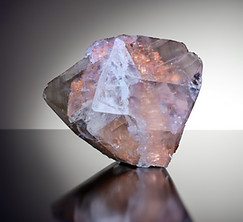
Copper included calcite
Click on any Image to magnify it.
October 2025 Submissions

madagascar Celestine
Description: Celestine
Location: Madagascar
Collection Method: Purchased
Camera: 105 Nikon lens, and a speedlight flash at ISO, f3.5, 1/250

ohio Calcite
Description: Calcite
Location: Pugh Quarry, NW Ohio
Collection Method: Purchased
Camera: 105 Nikon lens, and a speedlight flash at ISO, f3.5, 1/250
December 2025 Submissions

Golden barite
Description: Barite is barium sulfate, BaSO4. It forms a solid solution series with strontium (Ba,Sr)SO4, with 100% Barium being Barite and 100% Strontium being Celestite. Barite is mainly used in drilling fluids for gas and oil due to its high density. It is also used as a paint pigment.
This specimen contains monoclinic crystals of honey-colored barite. Barite can be found in other colors, including white, blue, gray, and even colorless, depending on the different impurities present during its crystallization. Barite is also formed in many crystal forms – tabular crystals, prisms, thin blades, nodules, and rosettes.
Location: Châtel-Guyon, Riom, Puy-de-Dôme, Auvergne-Rhône-Alpes, France
Collection Method: Purchased from CristoSud Minerals
Weight: 291 Grams
Size: 8 x 4.5 x 7 cm, Barite crystals 1.5 x 1 x 0.8 cm.

Rutile in Quartz
Description: Rutilated quartz is a variety of Quartz which contains needle-like inclusions of rutile (TiO2).The inclusions may be randomly distributed or in bundles, sometimes forming star-shapes. They usually look golden, but may be other colors. It is frequently used in jewelry. Brazil is one of the premier locations for rutilated quartz.
Location: Novo Horizonte, Bahia, Brazil
Collection Method: Purchased from CristoSud Minerals
Weight: 111 Grams
Size: 5.2 x 4.5 x 3.5 cm

Red Cloud WulfEnite
Description: Wulfenite is an ore of lead and molybdenum. It occurs in oxidation zones of lead deposits. It frequently forms as tabular crystals that are reddish to orangeish, though other colors such as brown occur. A noted locality for wulfenite is the Red Cloud Mine in Arizona. Crystals are deep red in color and usually very well-formed. Wulfenite was approved as the official state mineral of Arizona in 2017.
Location: Red Cloud Mine, Arizona, USA
Collection Method: Purchased from CristoSud Minerals
Weight: 37 Grams
Size: 5.5 x 4 x 1.5 cm; Largest crystal 1.2 cm across.

tourmaline on albite
Description: This specimen features Tourmaline (Elbaite), Albite (Clevelandite), and Quartz. Dark green elbaite with the largest crystal at 7 cm long. Ends are nicely terminated with flat tops and beveled edges. Nice vertical striations. The substrate is leafy white albite (clevelandite). And there is one large quartz perfectly terminated that is 5 cm long and 3.5 cm wide. As a gemstone, elbaite is a desirable member of the tourmaline group because of the variety and depth of its colors and the quality of the crystals. Originally discovered on the island of Elba, Italy, in 1913, it has since been found in many parts of the world.
Location: Stak Nala, Haramosh Mtns, Rondu, Gigit-Balistan, Pakistan
Collection Method: Purchased in 2024 at the Michigan Mineralogical Society’s Greater Detroit Gem, Mineral & Fossil Show
Weight: 210 Grams
Size: 7.5 x 7.5 x 7 cm
January 2026 Submissions

Adularia with Chlorite
Description: Adularia is a Potassium rich variety of feldspar. Adularia is often associated with chlorite in the famous alpine fissures of the French, Swiss, Austrian, and Italian Alps, which have provided the best crystals of this variety.
Chlorite, the green inclusion, is a magnesium/iron silicate with a wide range of compositions. Largest crystal 5 cm on edge.
Location: Val Cristallina, Val Medel, Medel, Surselva Region, Grisons, Switzerland
Collection Method: Purchased in 2025 from Lambert Fine Minerals
Weight: 209 Grams
Size: 7 x 7 x 6 cm
FEBRUARY 2026 Submissions

Lake Michigan Petoskey
Description: We have a place up north right on Lake Michigan, and a big hobby of mine is Petoskey stones. I find them on my beach, and sand and polish them myself. Last summer, I found one of the best stones ever…it is massive and absolutely remarkable. Picture is the front and back of the iconic fossil.
Location: Lake Michigan "Up North"
Collection Method: Self-Collected
Size: Approx. 8 x 5 inches


Herkimer Diamonds
The Story: A member of MMS in 1946, when I was 12, I was 16 years old, riding in my family car's back seat, reading a book, Getting Acquainted With Minerals. When I came to page 68, I read about the quartz crystals called "Herkimer Diamonds." I asked to see a map of New York and noted where they were. Herkimer and Middleville were just coming up. I asked my dad if we could stop there and see if we could find where to get these minerals.
We arrived in the small town of Middleville. Dad stopped at the post office, where we asked the postmaster if he knew where we could find these. The man said a Mr. A. Petre, a farmer, had such minerals and gave us his address. We drove there and knocked on the door. The man opened the door, and we asked him about the Herkimers. He grabbed a shovel and took us to a spot to dig just near his barn. Nearby, there was a pail and a water pump. Dad dug as I looked for flashing crystals to wash clean.
The man gave us a box to hold the crystals. We found many loose crystals that day. Soon we had a good handful of them. Finally, we went to the man's home and asked what we should pay him. He invited us in. He showed us crystals he would sell to us. I picked out some beauties and a handful of small ones. What a day! How excited I was as we went back to our car.
Location: Middleville, New York
Collection Method: Self-Collected
Size: Variable
March 2026 Submissions

calcite & Copper
Description: Fantastic glassy, translucent and striated Scalenohedral crystal with bright, well formed native Copper contained within – rare specimen!
Location: Quincy Mine, Hancock, Houghton County, Michigan
Collection Method: Purchased from an estate sale in Calumet Michigan in the late 1990’s
Weight: 138 Grams
Size: 5 x 6.5 x 3.7 cm

Mango Quartz
Description: This yellow/orange tipped quartz, or “Mango” quartz, was discovered in 2017. The colorful inclusion is believed to be the mineral Halloyosite.
Location: Cabiche, Quípama Mun., Western Boyacá Province, Boyacá Dept, Colombia
Collection Method: Purchased fall of 2022
Weight: 107 Grams
Size: 8.2 x 5.5 x 6.9 cm

Calcite
Description: Large cognac colored, twinned and doubly terminated Calcite crystal perched upon an off-white Calcite crystal with Chalcopyrite on its face.
Location: Rainbow Pocket, Fletcher Mine, West Fork, Reynolds County, Missouri, USA
Collection Method: Purchased at the Michigan Mineralogical Show in October of 2021
Weight: 735 Grams
Size: 16 x 7.5 x 9.2 cm


Fordite
Description: Although not a mineral it is in many rock, mineral and gem collections. And of course it’s not exclusively Ford. Carriers that transport new cars through an automotive assembly line get painted over and over, again and again. They also get baked to the hardness of an automotive finish and can be cut and polished much like a mineral. The geometry of the carrier and the target car color produce unique and interesting patterns. I personally worked as a supplier of coatings to industrial customers including automotive for 33 years. I only wish I had filled a shed with this stuff.
This example illustrates a revolution in automotive coating operations. Before the introduction of robotic electrostatic application equipment and automated cleaning of spray guns cars would be painted in batches of the same color to reduce clean-up and change-over. With the new process every car could be painted to order, reducing unnecessary inventory. One coat is between 0.3 and 0.5 mils thick. The sample in the photo is 0.75 inches wide or 750 mils. Microscopic analysis shows hundreds of lines representing runs of 1 to approximately 5 cars painted per change-over.
Collection Method: Gift from a representative
Weight: 4.7 Grams
Size: Oval L 1.125” – W 1” – H 0.2
Stibnite
Description: Antimony Trisulfide (picture represents a one-half inch section of the primary trunk.)
Complex, brittle, and shiny metallic crystals with an amazing natural patina. Note: Antimony has a similar effect on humans as arsenic does, handle with care. Stibnite is the primary ore for production of Antimony. Due to its critical role in defense, electronics, and energy storage, antimony is classified as a strategic or critical mineral by organizations such as the United States Geological Survey and the European Commission. Its supply is concentrated in a few countries, with China producing approximately 70% of the global output. Antimony’s versatility from fire safety and metal strengthening to electronics and pigments makes it an indispensable element in modern industry and technology. Stibnite’s combination of striking metallic crystals, historical significance, and industrial importance makes it a mineral of both scientific and cultural interest.
Location: Wuning Mine, Jiangxi Province, China
Collection Method: Purchased at the 2024 Michigan Mineralogical Show
Weight: 45 Grams
Size: L 5” – W 1.375” – H 1”
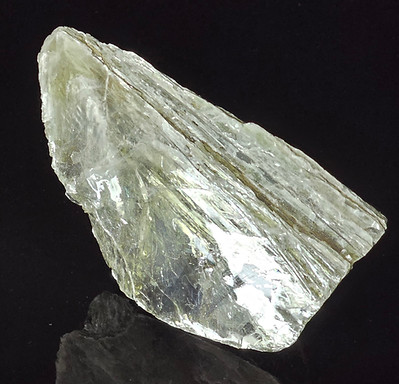
Spodumene
Description: Lithium-rich silicate. Highly reflective glassy surface. Resembles mica with significant differences in cleavage planes and hardness. Spodumene’s layers of prismatic crystals are cleavage planes while mica is paper thin layers and the harness of spodumene is three times that of mica. Spodumene is a significant source of lithium for batteries, ceramics, and other applications. Extraction is challenging due to the need for high temperatures and acid leaching due to tight binding of lithium in the crystal structure. With its vitreous luster and changes in color with different light sources spodumene is an excellent and visually striking addition to any collection. Spodumene's versatility and significance make it a fascinating mineral with a rich history and ongoing importance in various industries.
Location: Minas Gerais, Brazil
Collection Method: Purchased at the 2024 Michigan Mineralogical Show
Weight: 159 Grams
Size: L 4” – W 0.5” – H 3.75”
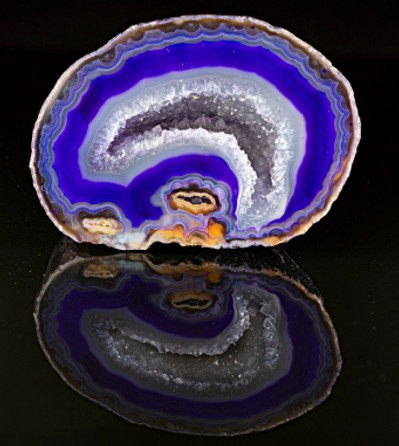
Chalcedony Quartz Geode
Description: Slice of a chalcedony-quartz geode. The specimen shows multiple concentric bands of agate (cryptocrystalline silica) enclosing an open vug lined with drusy quartz crystals. The banding is well developed and locally fortification-like. The intense purple color is interpreted as secondary dye enhancement, a common treatment in decorative agate slices.
Location: Melbourne Australia, 2026
Collection Method: Purchased

Peacock ore on quartz matrix
Description: This photograph highlights the iridescent surface colors characteristic of “peacock ore,” where metallic luster is overlaid by vivid hues of blue, purple, green, gold, and rose created by thin film interference of atomically think layers of surface oxides (Cu2O) of the bornite (Cu5FeS4) and chalcopyrite (CuFeS2). The radiating crystalline forms create a dynamic, almost flame-like geometry. The composition emphasizes both texture and chromatic intensity, inviting attention to the interplay between sulfide mineralization, surface alteration, and reflected light.
Location: Havre de Grace, Maryland, 2026
Collection Method: Purchased
Size: 57 mm × 40 mm × 40 mm

Asbestos
Description: (primarily Actinolite green crystals with secondarily Chrysotile white crystals). Sample in the photo is approximately one inch by one and one half inches. Nasty mineral! After being the miracle flame retardant mined and used in building materials for many years its health risks from inhaling the microscopic needle like fibrous crystals outweighed its benefits. Costs exceed $20B per year in the USA for remediation, abatement, healthcare and legal fees. The unintended reflection in the photo is ominous with respect to its dark side, accounting for over 2000 deaths from mesothelioma cancers per year in the USA alone.
Location: New Jersey, USA
Collection Method: Purchased at the 2025 Michigan Mineralogical Show
Weight: 12 Grams
Size: L 1.5” – W 1” – H 0.5”

Blue ARAGONITE
Description: Sparkly three-inch specimen in a light sea-foam green color (a popular color for the Toyota Prius twenty years ago). A calming, pale-to-deep blue carbonate mineral. Blue aragonite is known for its healing properties.
Location: Mexico
Collection Method: Purchased at the Michigan Mineralogical Summer Picnic
Weight: 67 Grams
Size: L 2.875” – W 1.5” – H 1.25”


coprolite
Description: (Fossil Poop) Unfortunately, I do not know what animal species left this for me to find but I am grateful! Both images are of the same coprolite.
Location: West of Albuquerque, NM and south of the Petroglyph National Monument
Collection Method: Self-Collected 2019

Aglow in Agate
Description: This polished section shows a chalcedony-quartz geode composed of concentric agate bands surrounding an open vug lined with drusy quartz crystals. The banding is strongly developed and locally fortification-like, forming nested contours around the central cavity. The vivid purple coloration is interpreted as secondary dye enhancement, superimposed on the natural silica banding. In this image, back illumination from a concealed (velvet tube from the top) LED light passes through a more translucent quartz-rich zone and produces a warm amber glow within the cavity, in striking contrast to the cool violet agate bands. The lighting also reveals traces of residual purple dye on parts of the drusy quartz lining, adding another layer of texture and color to the specimen.
Location: Melbourne Australia, 2026
Collection Method: Purchased


Purple Howlite
Description: In this portrait of tumbled purple howlite, color and pattern work together like watercolor held in stone. Violet and blue spread through the polished surface in delicate branching veins, while the mirrored reflection below gives the specimen a quiet, meditative presence. What might be held in the palm becomes, under careful light, a suspended world of color and lines.
Location: Melbourne, Australia, 2026
Collection Method: Purchased
Size: 10 mm × 12 mm × 10 mm
Peacock ore Plumage
Description: Under magnification, peacock ore reveals a brilliant interference tapestry of emerald, gold, violet, and magenta. These colors are the result of thin-film interference produced by nanometer-scale oxide layers on the mineral surface. As the thickness of the tarnish film changes across the specimen, likely within a range of roughly 50–200 nm, different wavelengths of light are reflected, creating shifting bands of color. The image captures a meeting of mineralogy and optics: a crystalline surface whose chemistry and structure are written in light.
Location: Havre de Grace, Maryland, 2026
Collection Method: Purchased
Size: 57 mm × 40 mm × 40 mm (field of view ~25 mm × 20 mm)


Enhydro Quartz
Description: This unique specimen is a very large, double-terminated, and skeletal enhydro quartz crystal self-collected in the mineral-rich mountains of San Luis Potosí, Mexico. It is an exceptional example of both crystal growth complexity and inclusion preservation. The crystal itself is mostly transparent with deep internal "windows" and intricate negative crystals, a classic elestial structure that highlights the dynamic growth history. The exterior shows typical developmental etching and minor iron staining, left untouched to maintain its raw field aesthetic. The true defining feature, however, is the presence of two verified moving enhydro bubbles trapped within larger internal cavities. These rare inclusions, containing ancient trapped liquids and often visible mineral solids (perhaps carbon), are prominently featured in the submitted photos. It is extremely rare to find such complex skeletal formations that also host such clear and mobile enhydros.
Location: Tamuin, San Luis Potosí, Mexico, 2021
Collection Method: Self Collected